
You know your child better than anyone.
That is why even a small change can catch your attention.
Maybe your child has become more irritable lately. Getting ready for school suddenly takes much longer. Homework that was once manageable now ends in frustration. Perhaps your child has stopped talking about their day or prefers to spend more time alone.
At first, it may seem like ordinary growing-up behaviour. Children have difficult days, and their moods can change quickly.
But when a change continues, becomes more intense, or starts affecting everyday life, it is worth looking a little deeper.
Children don’t always have the emotional vocabulary to explain what is happening inside them. Instead, their feelings can show up through their behaviour.
Sometimes, the behaviour is the part we can see, while the real difficulty is underneath.
There May Be More Behind the Behaviour
A child who feels anxious may become clingy or avoid situations that make them uncomfortable.
A child who feels left out at school may suddenly refuse to attend.
A child who is struggling academically may avoid homework altogether because starting it reminds them that they are finding the work difficult.
Even anger can have many different roots. A child may be frustrated, embarrassed, worried, tired, or struggling with something they haven’t learned how to express yet.
This doesn’t mean every difficult behaviour has a hidden emotional problem. Children still test boundaries, become frustrated, and have bad days.
The important thing is to notice the pattern behind the behaviour.
What has changed?
When does it usually happen?
Does it happen at home, at school, or in both places?
What seems to make it better or worse?
Looking at these details can give parents a much clearer picture of what their child may be experiencing.
When Shcould You Pay Closer Attention?
A single difficult day usually isn’t a reason for concern.
A noticeable change that continues over time deserves more attention, particularly when it begins affecting your child’s normal routine.
You may notice changes in:
- School attendance or willingness to go to school
- Sleep or eating habits
- Friendships and social interaction
- Concentration and schoolwork
- Mood and emotional reactions
- Interest in activities they previously enjoyed
- Confidence and independence
- Communication with family members
You may also notice physical complaints such as headaches or stomachaches, particularly around school or other stressful situations.
These symptoms can have many causes, so they shouldn’t automatically be linked to an emotional concern. However, when they appear alongside noticeable behavioural or emotional changes, they are worth discussing with an appropriate professional.
When a Child Becomes Quiet
Not every child shows distress through anger or challenging behaviour.
Some children go in the opposite direction.
They become quieter.
They stop sharing things with their parents. They spend more time in their room. They lose interest in playing with friends or participating in family activities.
Because there isn’t an obvious outburst, this can sometimes go unnoticed.
A quiet child may simply be tired or going through a normal period of change. But if the withdrawal is unusual for that child and continues, it deserves gentle attention.
Rather than putting pressure on them to explain everything, parents can keep the door open.
A calm conversation, a shared activity, or simply spending some one-to-one time together can sometimes create an opportunity for the child to open up naturally.
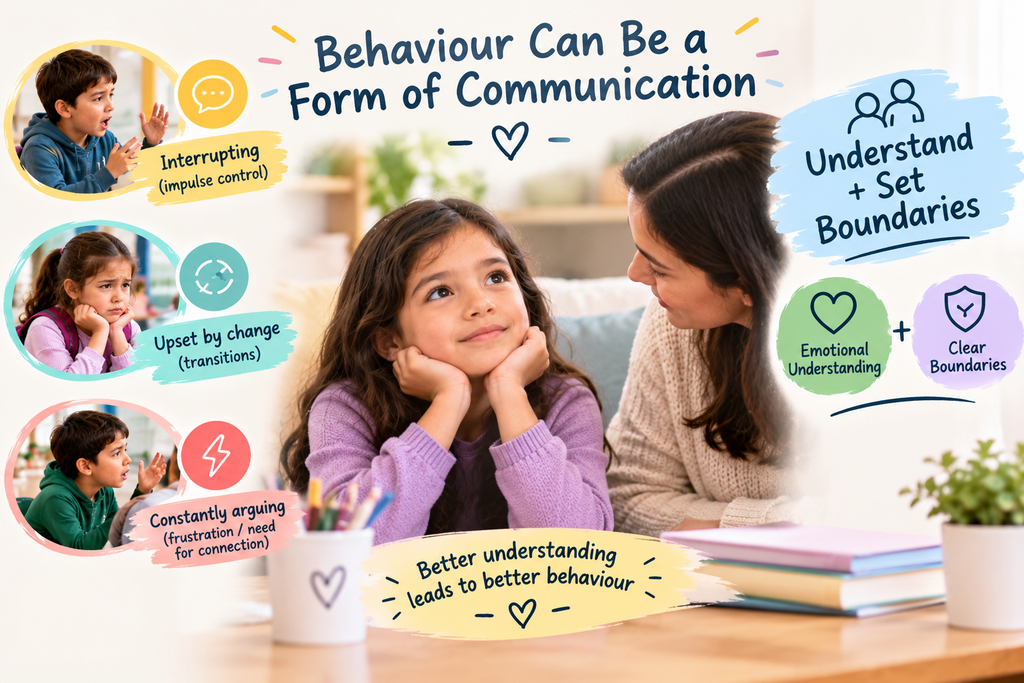
Behaviour Can Be a Form of Communication
Children often communicate through what they do before they can explain what they feel.
A child who keeps interrupting may be struggling with impulse control.
A child who becomes upset whenever plans change may be finding transitions difficult.
A child who constantly argues may be struggling with frustration or a need for more connection and attention.
This doesn’t mean parents should ignore inappropriate behaviour.
Boundaries are still important.
A child needs to learn that being angry doesn’t make it acceptable to hurt someone or break things. At the same time, correcting the behaviour without understanding what is driving it may only address the surface.
The most helpful approach often combines clear boundaries with emotional understanding.
When Parents Feel Exhausted
Supporting a child through repeated emotional or behavioural difficulties can be tiring.
Parents may spend hours trying to manage homework, school refusal, sibling arguments, tantrums, or difficult mornings.
Over time, even patient parents can become frustrated.
They may start reacting more strongly than they intended to, and then feel guilty afterwards.
This cycle can affect the whole family.
This is where counseling for parents and child can be useful. Supporting a child isn’t only about changing the child’s behaviour. Parents may also need guidance on communication, boundaries, emotional regulation, and ways to respond during difficult moments.
Getting support does not mean a parent has failed.
Sometimes it simply means the family needs a different approach.
The School Environment Matters Too
Children spend a significant part of their day at school, so difficulties there can have a noticeable effect on their behaviour at home.
A child may be struggling with friendships, academic expectations, classroom participation, bullying, or adjusting to a change in their environment.
Sometimes parents only see what happens after the child comes home.
Teachers may notice a different side of the child.
This is why child counselling in schools and appropriate communication between parents, teachers, and counsellors can be valuable.
When the adults around a child share relevant observations, it becomes easier to understand the bigger picture instead of judging the behaviour in isolation.
Looking Beyond “Good” and “Bad” Behaviour
It can be tempting to describe behaviour as simply good or bad.
But children are still learning how to manage frustration, communicate their needs, solve problems, and understand their emotions.
A child who struggles today may not have the same difficulty a year from now, especially when they receive consistent guidance and opportunities to practise new skills.
Instead of focusing only on stopping a behaviour, parents can also help children develop alternatives.
A child who usually screams when frustrated can learn to ask for a break.
A child who hits when angry can learn safer ways to express that anger.
A child who avoids difficult tasks can gradually learn how to ask for help.
These changes take time. They require patience and consistency rather than expecting a child to change after one conversation.
How Child Counselling Can Support Your Child
Child counselling provides a supportive space where children can explore emotions, experiences, and concerns in a way that suits their age and personality.
Children don’t always communicate through direct conversation. Depending on their developmental stage, a counsellor may use conversation, activities, creative expression, or other age-appropriate approaches to help a child feel comfortable and understood.
The purpose isn’t simply to make a child behave differently. It is to help them understand what they are experiencing and develop healthier ways of coping and communicating.
Parents can also gain a better understanding of what their child may need at home and how they can support their child’s emotional wellbeing and progress.
If you would like to learn more about how professional support can help your child, explore our child counselling service to understand the approach and support available.
You Don’t Have to Wait for a Crisis
Parents sometimes wait because they aren’t sure whether the situation is serious enough to seek support.
But counselling doesn’t have to begin only when a problem becomes overwhelming.
If you have noticed a significant change in your child’s behaviour and it continues to affect their school life, relationships, confidence, or everyday routine, speaking with a qualified counsellor can help you understand the situation more clearly.
Sometimes the concern turns out to be temporary.
Sometimes a child needs help developing emotional or social skills.
And sometimes there is a deeper concern that deserves more attention.
You don’t need to diagnose your child yourself before asking for guidance.
Your Child May Be Showing You Something
A change in behaviour doesn’t automatically mean something is wrong.
But it can be an invitation to pay closer attention.
Look at what is happening around the behaviour. Notice when it appears. Listen to what your child says, but also notice what they may be communicating without words.
Children are still learning how to understand and express their inner world.
With patience, healthy boundaries, and the right support, they can learn better ways to manage difficult emotions and communicate what they need.
Sometimes the most helpful response isn’t to ask a child to simply behave differently.
It is to become curious about what they are experiencing and what might help them feel understood.
Let’s Start a Conversation
If you have concerns about your child’s emotions, behaviour, relationships or wellbeing, you can reach out and share what you’re experiencing.